
By: Matt @ Home & Pocket
August 31, 2025
When I first came South for college, I was fascinated by the hold college football had on people.
I did not fully understand why people who had never attended a university could be so devoted to its team. Families planned weddings, vacations, and entire fall calendars around kickoff times. My wife would not even consider a fall wedding unless it landed on her team’s bye week. Years later, that team became mine too.
That is the magic of college football. It is inherited, shared, and deeply local. A fight song can bring back a childhood memory. A tailgate can function like a family reunion. Marching bands, mascots, student sections, and rivalries give the sport a character professional football cannot manufacture.
They also make an extraordinary amount of money.
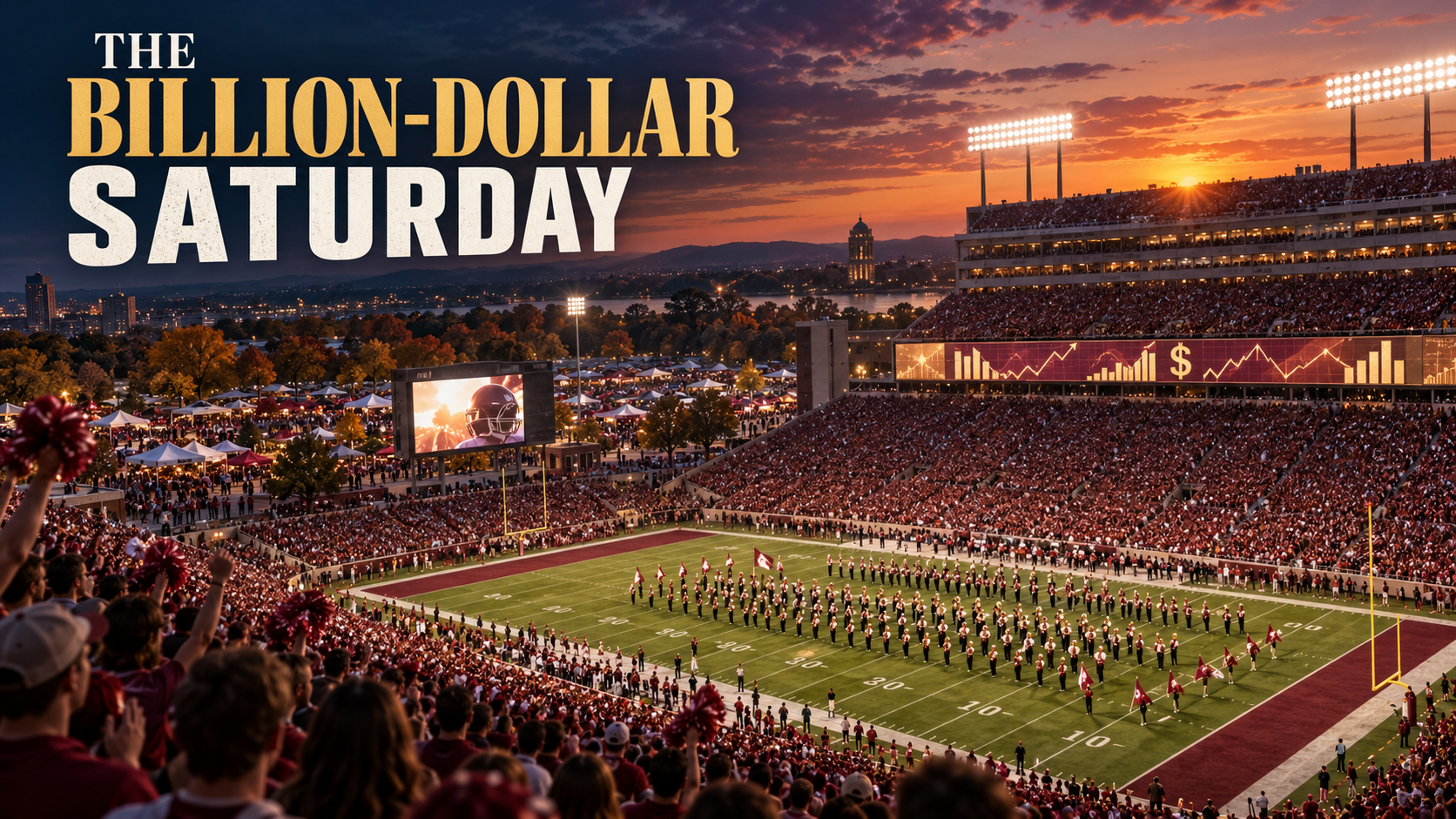
The modern sport is no longer merely a collection of Saturday games. It is a media property, a recruiting market, a tourism engine, a fundraising operation, and—since schools began sharing revenue directly with athletes in 2025—a compensation business.
College football’s greatest asset is not the stadium. It is the loyalty passed from one generation to the next.
That does not mean the sport has lost everything that made it special. It does mean fans should understand the business now operating behind the traditions they love.
First, Follow the Television Money
The easiest way to understand modern college football is to start with the broadcasts.
In 2024, ESPN agreed to a six-year extension for the College Football Playoff through the 2031–32 season. The deal was valued at $7.8 billion—about $1.3 billion per year before considering the many other regular-season conference packages.
That is only the postseason. The Big Ten’s seven-year agreements with Fox, CBS, and NBC have commonly been valued at roughly $7 billion. The SEC’s long-term relationship with ESPN and ABC, conference networks, sponsorships, tickets, premium seating, licensing, and bowl revenue add more layers.
The result is a system in which kickoff times, conference membership, playoff access, and even traditional rivalries are increasingly evaluated through the lens of media value.
The clearest recent example is the Big Ten. For the fiscal year ending June 2025, the conference reported distributing $1.37 billion to its 18 member schools. The previous year’s total was $883 million. The increase reflected the first full year of new media agreements, four new West Coast members, and revenue from the expanded playoff.

That does not mean every member received an identical check or that every dollar came from football. It does show the scale of the machine. A major conference is no longer simply a scheduling alliance. It is a negotiating bloc selling live programming—one of the few forms of television audiences still prefer to watch in real time.
Realignment makes more sense when viewed this way. USC and UCLA joining a conference historically centered in the Midwest looked strange on a map. It looked much more logical on a spreadsheet.
Revenue Is Not the Same as Profit
Big numbers can be misleading.
An athletic department may report enormous revenue and still spend nearly all of it. Schools pay for coaching staffs, scholarships, recruiting, travel, medical care, nutrition, facilities, administration, game operations, debt service, and dozens of teams that do not generate major ticket or television income.
The NCAA’s financial reporting shows wide differences across subdivisions and schools. The richest brands operate in a different universe from smaller Football Bowl Subdivision programs, Football Championship Subdivision schools, and institutions in Divisions II and III.
Football can subsidize the rest of an athletic department at a major program. At another school, football itself may require institutional support or student fees.
That distinction matters because phrases such as “college football made billions” can imply that every campus is awash in cash. It is closer to say that the industry produces billions while the largest brands and conferences capture a disproportionate share.
This creates an arms race:
- Better facilities help recruiting.
- Better recruits improve the odds of winning.
- Winning increases television exposure, ticket demand, donations, and merchandise sales.
- New revenue funds the next round of facilities, staff, and recruiting.
Once a school enters that cycle, slowing down can feel more dangerous than spending more.
In college athletics, record revenue often creates a larger budget—not a larger margin.
That lesson should sound familiar to families. Higher income does not automatically create wealth if every raise is immediately assigned to a larger house, a newer vehicle, or a more expensive lifestyle.
Players Are No Longer Outside the Business
For decades, the people producing the product were restricted from sharing openly in much of its commercial value.
That began to change in July 2021, when college athletes were allowed to earn money from their name, image, and likeness. NIL opened the door to endorsements, appearances, social-media promotions, camps, autograph signings, and local sponsorships.
Then came a more fundamental change.
The House settlement, approved in 2025, established nearly $2.8 billion in back damages for former athletes and allowed participating Division I schools to share revenue directly with current athletes. The initial school payment cap was $20.5 million for 2025–26, with the cap expected to rise by roughly 4 percent per year.

NIL and revenue sharing are related, but they are not the same thing:
- Third-party NIL is money paid by a business or other outside party for a legitimate commercial use of an athlete’s name, image, or likeness.
- School revenue sharing is direct compensation from the institution under the post-settlement model.
- Scholarships and other benefits generally sit outside the revenue-sharing cap.
The old amateur model has not merely been adjusted. Its foundation has changed.
That is good in one obvious respect: athletes whose work helps generate enormous revenue can now participate more directly in it. It also creates difficult questions about competitive balance, Title IX, roster limits, contract enforcement, transfer decisions, taxes, and what happens when a teenager receives life-changing money before developing life-changing judgment.
The financial opportunity is real. So is the need for guardrails.
Athletes and their families should treat compensation the way a young business owner would:
- Set aside money for taxes before spending anything.
- Separate short-term cash from long-term investments.
- Understand every contract and termination clause.
- Be cautious with advisers, agents, friends, and family members seeking access.
- Remember that a high-earning season is not the same as a permanent career.
The NCAA notes that the overwhelming majority of college athletes will go professional in something other than sports. Even for a star, the degree, network, reputation, and money retained after the spotlight fades may matter more than the biggest headline valuation.
The Business Still Depends on Tradition
Here is the paradox: the sport keeps commercializing the very traditions that make it valuable.
Television does not pay billions merely for 22 players and a scoreboard. It pays for packed stadiums, rivalry stakes, recognizable colors, student sections, fight songs, and decades of emotional investment.
Even the marching band has measurable value. A published study using nine seasons of Division II games found that the presence of a marching band and an academic music program each had an independent positive relationship with attendance after controlling for other factors.
That finding makes intuitive sense. The band is not background decoration. It is part of the product.
So are Midnight Yell at Texas A&M, Script Ohio, Virginia Tech’s entrance to “Enter Sandman,” the Tiger Walk traditions across the South, and the Army–Navy Game. They work because they were built over time. They cannot be created in a conference office or replicated through a marketing campaign.
This is where college football’s leaders should be careful. If every decision is made for the next rights negotiation, the sport may gradually weaken the loyalty that made those rights so valuable.
Regional conferences reduced travel and kept rivalries alive. Reasonable kickoff times made it easier for families to attend. Stable rosters allowed fans to know the players. Bands, students, and alumni—not just luxury suites and television windows—made the stadium feel like a college stadium.

Growth is not automatically bad. But a business can damage its brand when it treats its most loyal customers as if they will tolerate anything.
What Game Day Really Costs a Family
For a family, the economics are much smaller—but no less real.
A single major game can include:
- Four tickets
- Parking or a shuttle
- Fuel or lodging
- Food inside and outside the stadium
- Team apparel
- Childcare or pet care
- Streaming subscriptions for the rest of the season
The total can move from a couple hundred dollars to well over $1,000, particularly for a rivalry, neutral-site game, or overnight trip.
There is nothing wrong with spending money on something your family values. The problem begins when enthusiasm replaces a plan.
A simple approach is to create a football-season sinking fund. Decide what the season is worth to your household, divide that amount by 12, and save it monthly. If the annual budget is $1,800, set aside $150 per month. When tickets become available, the money is already there.
Also decide which experience matters most. One great game in person, a modest tailgate, and family watch parties for the rest of the season may produce better memories than chasing every road trip and paying interest on the credit card afterward.
A tradition is worth preserving. Debt is not required to preserve it.
The same rule applies to streaming. Audit subscriptions before the season, identify which services actually carry your team, and cancel what you do not need when the season ends. Convenience charges become permanent household expenses when nobody circles back.
Do College Towns Really Win?
On a home Saturday, the impact feels obvious. Hotels fill, restaurants add staff, short-term rentals command premiums, and downtown sidewalks overflow.
For individual businesses near a stadium, those weekends can be among the most important of the year. A restaurant owner, parking operator, hotel, or rental-property owner may see a direct and meaningful lift.
The broader economic claim requires more caution.
Academic research examining decades of data across 63 metropolitan areas found no statistically significant evidence that college football games produced a broad, lasting increase in host-area income. One reason is substitution: local households may spend at the stadium instead of at another local business. Another is leakage: some revenue goes to national hotel chains, broadcasters, vendors, or people who live elsewhere.
Both observations can be true:
- Game day can be extremely valuable to particular businesses and neighborhoods.
- The total regional economy may not become permanently richer simply because a team plays six or seven home games.
That nuance is more useful than the usual promotional estimate claiming every big game “creates” a huge amount of money. Gross visitor spending is not the same as new local wealth.
For real-estate investors, the same restraint applies. A college town may offer strong short-term rental demand, but a purchase still has to work after accounting for seasonality, local regulations, management, cleaning, repairs, vacancy, insurance, and the possibility of a losing season. A handful of premium weekends should strengthen a sound deal—not rescue a weak one.
Who Wins—and Who Carries the Risk?
The new system has clear winners.
Networks receive valuable live programming. Conferences gain bargaining power. Top programs collect larger distributions and national exposure. Coaches and administrators can command higher salaries. Athletes can finally earn from their market value. College towns enjoy bursts of visitors and attention.
The risks are spread more widely.
Fans pay higher prices and manage more subscriptions. Athletes navigate short careers and uncertain rules. Non-revenue sports face pressure when budgets tighten. Smaller programs stretch to compete with schools whose annual conference distribution can exceed another department’s entire budget. Universities may take on facility debt based on the assumption that future media money will keep rising.
This is why the next decade may be less about whether college football is a business—it clearly is—and more about whether the business remains stable.
The open questions are substantial:
- Will athletes eventually be treated as employees?
- Will there be collective bargaining?
- Can a national rule replace the state-by-state NIL patchwork?
- How will revenue sharing interact with Title IX?
- Will the largest programs break further away from the rest of Division I?
- How much more will families pay before attendance or subscriptions soften?
The money is larger than ever, but so are the obligations attached to it.
Four Money Lessons Families Can Take From the Sport
1. Revenue does not equal wealth
A program can bring in record revenue and spend every dollar. A household can do the same. Track the gap between what comes in and what goes out; that margin, not income alone, creates options.
2. Protect the assets that cannot be replaced
For college football, those assets are loyalty, identity, and tradition. For a family, they are time, trust, health, and shared experiences. Do not sacrifice the permanent things while chasing the newest upgrade.
3. Prepare before the rules change
Realignment, NIL, and revenue sharing changed college sports quickly. Tax rules, careers, markets, and interest rates change too. Cash reserves, manageable debt, and multiple income streams give a family room to adjust.
4. Know when “more” stops improving the experience
Better seats, another streaming package, and one more road trip all have diminishing returns. Spend deliberately on what your family will remember, then stop.

The Final Whistle
College football has not stopped being a tradition. It has become a business built on tradition.
The bands still play. Families still return to the same tailgate spots. Children still learn the fight song before they understand the rules. The Army–Navy Game still represents something far larger than a television rating.
But behind those moments are billion-dollar contracts, conference distributions, athlete payments, donor collectives, facility debt, and relentless competition for attention.
Fans do not need to reject the modern game. They should see it clearly.
Enjoy the Saturday. Wear the colors. Teach the kids the traditions. If going to a game matters to your family, plan and save for it without apology.
Just remember what the sport itself sometimes forgets: the money is supposed to support the experience. The experience should not exist merely to extract more money.
Because long after the media contracts expire and the conferences realign again, what people will remember is not the revenue report.
They will remember who sat beside them when the band took the field.
Sources and Further Reading
- Big Ten Announces Record Revenue Distribution to Members
- ESPN and College Football Playoff strike a six-year extension
- What the NCAA settlement means for colleges and state legislatures
- NCAA: Finances of Intercollegiate Athletics
- Does a marching band affect college football attendance?
- Assessing the Economic Impact of College Football Games on Local Economies
As Always – Thanks for Reading and Please Subscribe Below!






Leave a Reply