
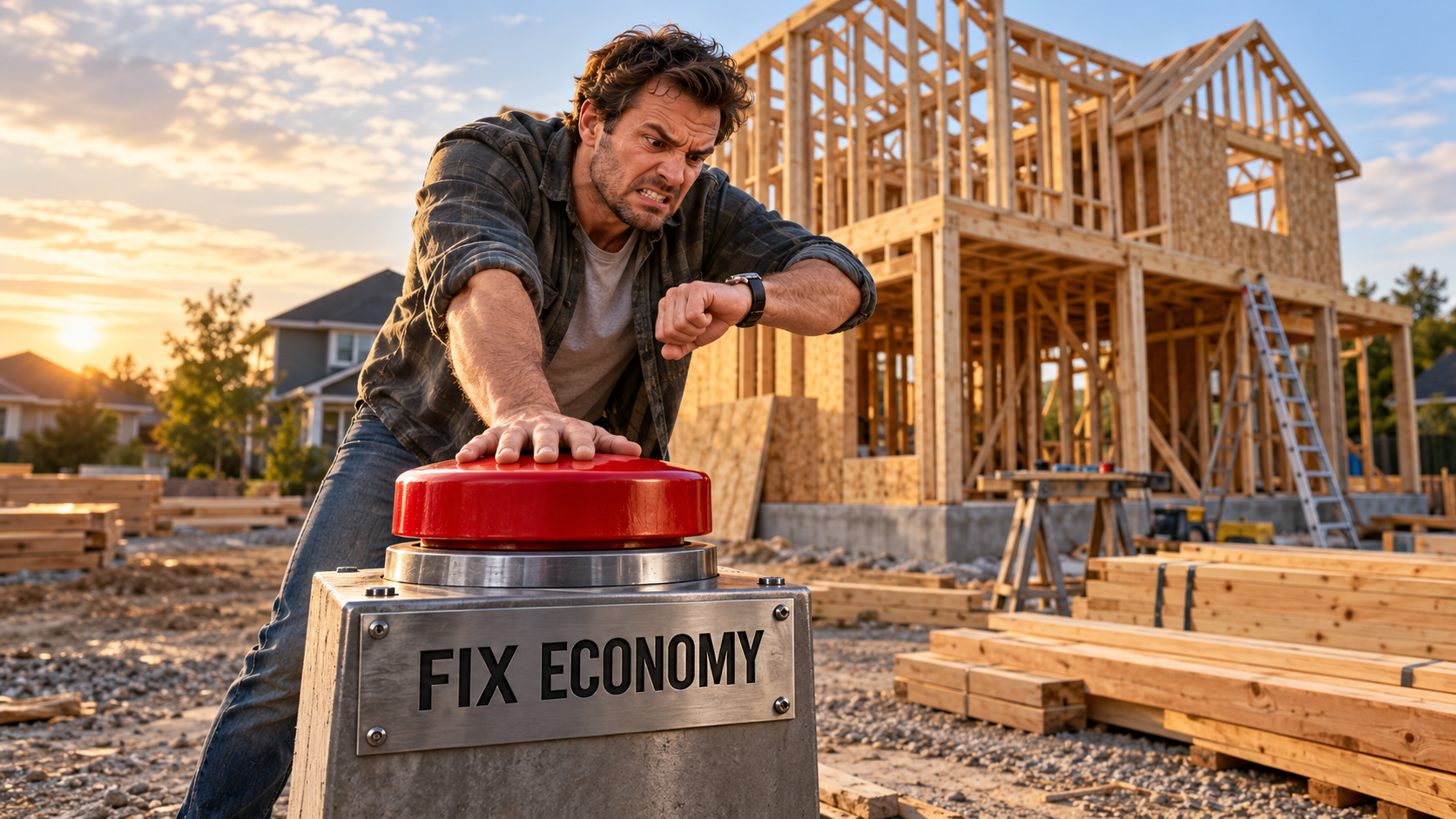
Why mortgage rates, housing prices, and inflation refuse to cooperate with our demand for cheap, fast, and now.
By Matt | Home & Pocket
October 3, 2026
Opening Statement: The economy does not offer overnight shipping. Mortgage rates are not set by presidential mood, lower inflation does not mean yesterday’s prices return, and fixing housing takes more than a campaign promise. Understanding those differences will do more for your finances than another angry comment.
We can have dinner delivered in thirty minutes, a package delivered tomorrow, and an opinion delivered before we have read the article. Apparently, we now expect the American economy to offer the same service.
Prices should fall.
Mortgage rates should drop.
Our investments should rise.
Our homes should appreciate.
And whoever is in office should make all of that happen immediately.
Quite the reasonable little shopping list.
I have been digging into why mortgage rates are climbing when buying a home already feels like qualifying for a second career.
The more I read, the more obvious something becomes: we keep demanding simple answers from a system with competing pressures, different decision makers, and consequences that arrive on different schedules.
Then we get mad when reality refuses to fit on a bumper sticker.
First, the housing frustration is real
Let’s get this out of the way: struggling to afford a home does not make someone financially irresponsible or stupid. High borrowing costs and high prices can squeeze people who have done plenty right.
But genuine frustration does not make every explanation correct.
Freddie Mac reported an average 30-year fixed mortgage rate of 7.28% for the week ending October 1, 2026, up from 7.03% the previous week. That is a national survey average, not a promise about the rate any particular borrower will receive.
Here is what the interest rate alone does to a hypothetical $400,000 loan, paid over thirty years:
| Fixed interest rate | Monthly principal and interest |
|---|---|
| 3.00% | $1,686 |
| 5.00% | $2,147 |
| 7.28% | $2,737 |
| 8.00% | $2,935 |
Calculated payments, rounded to the nearest dollar. Same loan amount and term throughout. Excludes property taxes, insurance, mortgage insurance, HOA fees, maintenance, and closing costs. These are scenarios, not historical average payments.

At 7.28%, that loan costs about $1,051 more per month than at 3%, before all the other expenses of owning a home.
You do not need an economics degree to understand that. You need a calculator and a moment to recover.
The president does not have a mortgage-rate remote
There is no button behind the Resolute Desk marked “Affordable Starter Homes.”
The Federal Reserve makes monetary policy decisions with independence from day-to-day political direction, while remaining accountable to Congress.
Its core objectives include maximum employment and stable prices.
On September 16, the Fed raised its federal funds target range by a quarter percentage point to 3.75%–4.00%. That benchmark concerns short-term borrowing between banks. It is not the rate printed on your thirty-year mortgage offer.
Long-term mortgage pricing depends on financial markets, including Treasury yields and mortgage-backed securities. Investors care about future inflation, future interest rates, and the risks of lending for years. Lenders also price in costs and margins.
The Fed influences that environment. It does not hand your lender a universal mortgage price list.
That is why a Fed rate cut does not guarantee that mortgage rates fall by the same amount—or fall at all. Expectations can change before a meeting, and longer-term rates can move differently from the overnight benchmark.
Unfortunately, “several markets are reacting to changing expectations” is less satisfying than “my least favorite politician did it.”
Less satisfying does not make it less true.
Why raise rates when everything already costs too much?
Because an expensive economy and an inflationary economy are related problems, but they are not identical.
The price level tells you how expensive things are. Inflation tells you how fast prices are changing.
For a simple, hypothetical example, take a basket of goods costing $100. After 10% inflation, it costs $110. If inflation then slows to 2%, the basket costs $112.20.
Inflation improved. Your old price did not return.

Slower inflation means the upward climb has slowed. Falling prices would mean something different. BLS makes this distinction when describing disinflation: prices can keep rising, just more slowly. [6]
So when someone says, “They claim inflation is down, but my groceries still cost more,” that observation can be completely accurate. The misunderstanding starts when we assume the two statements cannot coexist.
Math has once again ruined a perfectly good argument.
Higher rates are one way the Fed restrains spending and borrowing to reduce inflation pressure. They can make a financed purchase less attractive, slow business expansion, and discourage some demand.
But the Fed cannot manufacture lumber, build a subdivision, or repair an energy supply disruption with an interest-rate announcement. Supply shocks can push inflation up while hurting economic activity. Fighting them involves uncomfortable tradeoffs.
There is no painless setting on the control panel.
Higher rates do not guarantee cheaper houses

The easy story goes like this: borrowing gets expensive, buyers disappear, sellers panic, and everyone finally gets a bargain.
Lovely. When does the movie come out?
The complication is supply.
Consider an owner with a low fixed mortgage rate. Selling means giving up that loan and potentially financing the next home at a much higher rate. Unless moving is necessary, staying put may look pretty attractive.
That is the mortgage lock-in effect. Higher rates can discourage buyers and potential sellers at the same time. The Fed has documented how this can thin the existing-home market and support prices even as demand weakens.
Construction has its own constraints. Land, labor, materials, financing, approvals, and buyer demand all affect whether a project makes sense. Restricting demand does not instantly create more homes.
Some sellers will cut prices. Some builders will offer incentives. Some markets will soften more than others. None of that means every neighborhood owes you a crash.
Also, a lower purchase price does not automatically mean a lower monthly payment. Financing matters. So do taxes, insurance, and the roof that has apparently decided retirement starts next spring.
Housing affordability is a calculation, not a vibe.
“High rates mean the economy is great,” right?
Sometimes strong growth contributes to higher rates. Strong demand can create inflation pressure, and investors can adjust their expectations accordingly.
But high rates are not a certificate of economic excellence.
Rates can also reflect inflation concerns, uncertainty, or the extra compensation investors want for holding long-term debt. Inflation itself can come from supply problems, not just people enthusiastically spending bigger paychecks.
The national economy can expand while a particular household struggles. BEA’s latest estimate put real GDP growth at an annualized 2.2% in the second quarter of 2026. That measures overall inflation-adjusted production; it does not tell us whether your rent, wages, or household budget improved.
A growing economy and a miserable housing search can exist at the same time.
Apparently, the country contains more than one person. Inconvenient, I know.
Politicians influence the economy. They do not own every outcome
Presidents and Congress make consequential decisions about taxes, spending, trade, and regulation. Those decisions can affect demand, business costs, investment, and borrowing conditions.
They deserve scrutiny.
But influence is not total control. A serious argument identifies a policy, explains how it changes economic incentives or costs, and considers timing and other forces. “Everything got expensive while that guy was president” skips most of the work.
The opposite shortcut is just as lazy: “The Fed is independent, so elected officials cannot be responsible for anything.”
We do not need to choose between presidential omnipotence and presidential innocence.
We need evidence.
Of course, evidence takes longer than pointing at a campaign sign. That is probably why campaign signs remain so popular.
Economic policy does not come with a delivery tracker
A financial market can react to a policy announcement almost immediately.
Changing borrowing decisions, business investment, hiring, and inflation takes longer. Monetary policy affects economic activity and prices with a lag.
But there is no universal timer saying every policy works in precisely twelve months, eighteen months, or one presidential term.
A change in a tax withholding schedule can affect paychecks relatively quickly. A housing development still needs planning, approvals, financing, construction, and buyers. Those are different processes, not different shipping options.
And a delay is not proof that a policy is good. Bad policies can take time to reveal their damage. Good intentions can produce disappointing results.
The adult response is to track outcomes and adjust. Our preferred response seems to be checking twice, declaring failure, and demanding a refund from the economy.
Patience means giving a process time while paying attention. It does not mean applauding indefinitely because someone promised a wonderful result.
What I can actually control
I cannot set Treasury yields. I cannot make the Fed call me before a meeting. I cannot negotiate with inflation by posting in all caps.

I can improve my own position.
As I wrote in my recent SUV payoff article, I sold investments to eliminate that payment.
The decision reduced my dividend portfolio, but it also removed my final consumer debt and freed cash flow for rebuilding. Mortgages remain. The point was to give my household more room to maneuver.
That is the approach I want to carry into an uncertain economy:
- Judge a purchase by the full cost. A lender’s approval is not a household budget.
- Keep breathing room. A repair or income disruption should not depend on a perfectly timed rate cut.
- Treat refinancing as an option. A future lower rate is not guaranteed.
- Watch your local housing market. National averages cannot describe every street.
- Keep learning before reacting. Read the date, the source, and what the number actually measures.
None of this makes housing magically affordable. It makes decisions more deliberate.
That is less exciting than predicting the perfect bottom. It is also considerably more useful.
The conclusion: grow up before you go broke
We want cheap borrowing, rising home values, lower prices, higher wages, booming investments, and immediate results.
Sometimes those goals pull against each other.
Being upset about that is understandable. Refusing to understand it is a choice.
The economy will not get easier because we demand a simpler explanation. A politician cannot promise away every tradeoff. An AI answer cannot turn an agreeable sentence into a fact.
Learn what drives the numbers. Hold policymakers accountable for decisions you can actually connect to outcomes. Build a household budget that can survive something less convenient than your preferred forecast.
The economy does not owe us instant gratification. Our families deserve better than decisions built around it.
Cheap, fast, and now works fine when ordering a sandwich. It is a lousy foundation for a thirty-year financial commitment.
Thanks for Reading and Be Sure to Subscribe Below!




Leave a Reply