

By: Matt @ Home & Pocket
February 10, 2025
Maintaining a balanced and diversified portfolio is key to managing risk and achieving long-term financial goals.
By spreading investments across various asset classes and sectors, you reduce the impact of market volatility and ensure that no single investment or sector has an outsized influence on your overall performance.
A well-diversified portfolio provides a cushion against downturns in any one area, helping you weather economic uncertainty. Additionally, diversification allows for the opportunity to capture growth from multiple sources, increasing the potential for long-term returns.
Here are some strategies to help you keep your portfolio well-diversified and balanced:
1. Understand Your Risk Tolerance and Investment Goals
“Risk comes from not knowing what you’re doing.”
-Jim Rogers
- Risk Tolerance: Assess how much risk you’re willing to take. This will determine your asset allocation (e.g., the percentage of stocks, bonds, or other assets in your portfolio).
- Investment Goals: Clarify whether you’re investing for long-term growth, retirement, income generation, or short-term goals. This helps you choose appropriate investments.
2. Diversify Across Asset Classes
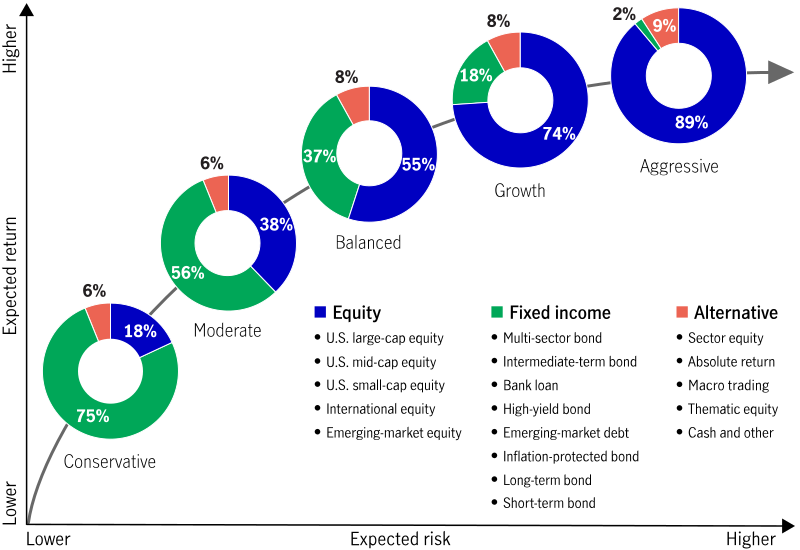
- Equities (Stocks): These provide growth potential but come with higher risk. You can diversify across sectors (e.g., tech, healthcare, finance), regions (e.g., US, international, emerging markets), and market caps (e.g., large-cap, mid-cap, small-cap).
- Bonds: They provide stability and income, but usually have lower returns than stocks. You can diversify by issuing entities (government, corporate), maturity (short-term, long-term), and credit quality (investment grade, high yield).
- Alternative Investments: These may include real estate, commodities, or hedge funds. These assets often have low correlations with stocks and bonds, reducing overall portfolio risk.
3. Sector and Industry Diversification

- Don’t concentrate too much on one sector or industry. For example, you might diversify across technology, consumer goods, energy, healthcare, and utilities.
- Consider ETFs or mutual funds that track diverse sectors if you prefer a hands-off approach.
4. Geographical Diversification
- Investing internationally helps mitigate risks tied to any single country’s economy.
- Use international stocks, bonds, or global funds to spread risk across different markets and economies.
5. Rebalance Regularly
- Over time, some assets in your portfolio will outperform others, causing your portfolio’s allocation to drift from your target. Rebalancing involves selling over-performing assets and buying under-performing ones to return to your desired asset allocation.
- Rebalance quarterly, semi-annually, or annually, depending on your preference and investment strategy.
- My Oil Stocks have been my “Biggest Gainers” in the portfolio. I’ve had to sell my profits and reinvest in other areas.
6. Use Dollar-Cost Averaging
- Invest a fixed amount of money regularly (e.g., monthly) regardless of market conditions. This strategy can reduce the impact of market volatility and help you buy more shares when prices are low and fewer shares when prices are high.
- This is also why I buy small amounts at a time and initiate a new position with only “1-Share”.
7. Consider Low-Cost Index Funds and ETFs
- Index funds and ETFs are effective tools for diversification, as they provide exposure to a wide range of securities within a particular index or sector.
- They are also typically low-cost, which helps keep more of your investment returns.
Here are some of the top-performing index funds over the past 5 years:
- Invesco Semiconductors ETF (PSI): +203.8%
- Global X Uranium ETF (URA): +203.5%
- Global X Copper Miners ETF (COPX): +202.5%
- Franklin International Low Volatility High Dividend Index ETF (LVHI): High dividends with a 4.7% yield
- Vanguard S&P 500 Growth Index Fund: +111%
8. Keep a Cash Allocation for Liquidity
- Keep a portion of your portfolio in cash or cash equivalents for liquidity, emergencies, or investment opportunities that arise during market dips. A common range is 5-10%, depending on your financial goals and risk tolerance.
- I always keep cash on hand, both in a savings and in my brokerage account.
9. Understand Tax Implications
- Tax-efficient investing, such as using tax-deferred accounts (e.g., IRAs or 401(k)s) for bonds and tax-efficient funds for equities, can help you minimize your tax burden and preserve returns.
- Keep an eye on tax implications when re-balancing or selling investments.
10. Review and Adjust Based on Life Changes
- Major life events (e.g., marriage, children, retirement, career changes) may affect your investment objectives and risk tolerance. Adjust your portfolio accordingly to align with new goals and time horizons.
Example of a Balanced Portfolio
A typical balanced portfolio could look like this (based on moderate risk tolerance):
- 60% Equities (diversified across sectors and regions)
- 30% Bonds (mix of government, corporate, and international bonds)
- 10% Cash and Alternatives (such as real estate or commodities)

A balanced portfolio featuring dividend stocks from different sectors offers a diversified approach to investing, helping to reduce risk while ensuring a steady stream of income.
By including stocks from a variety of industries, such as healthcare, utilities, consumer staples, and financials, investors can hedge against sector-specific downturns.
This strategy combines the stability and predictability of dividend-paying companies with the potential for long-term growth across multiple sectors, creating a well-rounded investment portfolio that is less vulnerable to market volatility.
I balance my portfolio by carefully selecting over 50 dividend-paying stocks, ensuring a diverse representation across all sectors, such as healthcare, technology, consumer goods, utilities, and financials.
This sector diversification helps minimize risk, as I am not overly reliant on any one industry.
I also maintain a consistent percentage allocation across each stock, allowing for equal exposure and reducing the impact of any single investment’s performance on the overall portfolio.
In addition to my stock holdings, I keep a small cash reserve to provide flexibility and liquidity for any potential opportunities or market fluctuations.
Beyond stocks, I hold real estate, which offers both potential appreciation and income through rent, further diversifying my assets.
Lastly, I regularly contribute to a 401k for long-term growth and tax advantages, ensuring I have a solid foundation for retirement.
This multi-faceted approach allows me to effectively manage risk while striving for steady income and long-term financial security.
By following these strategies and regularly reviewing your portfolio, you can ensure that your investments remain aligned with your risk tolerance, goals, and time horizon while minimizing potential losses during market downturns.






Leave a Reply